 4e1de1fc59
18c5b23a0f[test] Test that -blocksonly nodes still serve compact blocks. (Niklas Gögge)a79ad65fc2[test] Test that getdata(CMPCT) is still sent on regular low bandwidth connections. (Niklas Gögge)5e231c116b[test] Test that -blocksonly nodes do not send getdata(CMPCT) on a low bandwidth connection. (Niklas Gögge)5bf6587457[test] Test that -blocksonly nodes do not request high bandwidth mode. (Niklas Gögge)0dc8bf5b92[net processing] Dont request compact blocks in blocks-only mode (Niklas Gögge) Pull request description: A blocks-only node does not participate in transaction relay to reduce its own bandwidth usage and therefore does not have a mempool. The use of compact blocks is not beneficial to such a node since it will always have to download full blocks. In both high- and low-bandwidth relaying the `cmpctblock` message is sent. This represent a bandwidth overhead for blocks-only nodes because the `cmpctblock` message is several times larger in the average case than the equivalent `headers` or `inv` announcement. 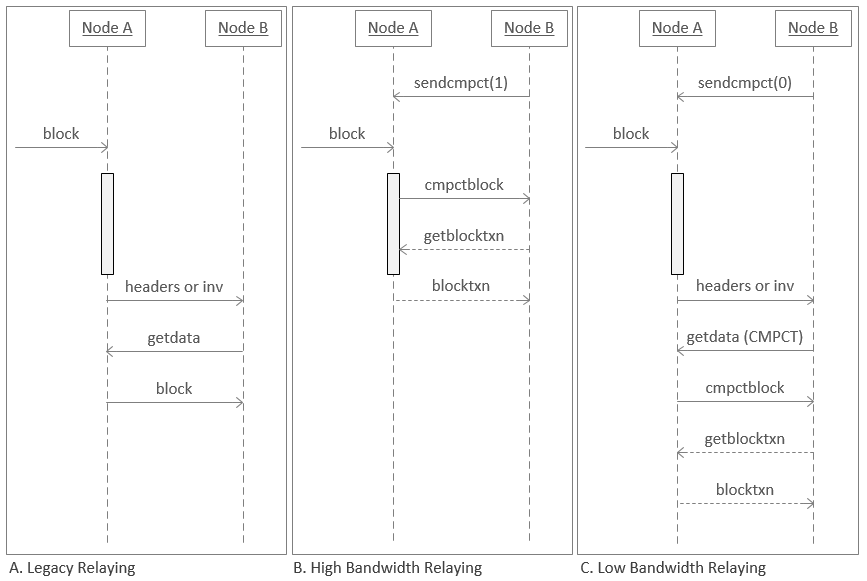 >**Example:** >A block with 2000 txs results in a `cmpctblock` with 2000*6 bytes in short ids. This is several times larger than the equivalent 82 bytes for a `headers` message or 37 bytes for an `inv`. ## Approach This PR makes blocks-only nodes always use the legacy relaying to download new blocks. It does so by making blocks-only nodes never initiate a high-bandwidth block relay connection by disabling the sending of `sendcmpct(1)`. Additionally a blocks-only node will never request a compact block using `getdata(CMPCT)`. A blocks-only node will continue to serve compact blocks to its peers in both high- and low-bandwidth mode. ACKs for top commit: naumenkogs: ACK18c5b23a0frajarshimaitra: tACK18c5b23a0fjnewbery: reACK18c5b23a0ftheStack: re-ACK18c5b23a0f🥛 Tree-SHA512: 0c78804aa397513d41f97fe314efb815efcd852d452dd903df9d4749280cd3faaa010fa9b51d7d5168b8a77e08c8ab0a491ecdbdb3202f2e9cd5137cddc74624

Functional tests
Writing Functional Tests
Example test
The file test/functional/example_test.py is a heavily commented example of a test case that uses both the RPC and P2P interfaces. If you are writing your first test, copy that file and modify to fit your needs.
Coverage
Running test/functional/test_runner.py with the --coverage argument tracks which RPCs are
called by the tests and prints a report of uncovered RPCs in the summary. This
can be used (along with the --extended argument) to find out which RPCs we
don't have test cases for.
Style guidelines
- Where possible, try to adhere to PEP-8 guidelines
- Use a python linter like flake8 before submitting PRs to catch common style nits (eg trailing whitespace, unused imports, etc)
- The oldest supported Python version is specified in doc/dependencies.md. Consider using pyenv, which checks .python-version, to prevent accidentally introducing modern syntax from an unsupported Python version. The CI linter job also checks this, but possibly not in all cases.
- See the python lint script that checks for violations that could lead to bugs and issues in the test code.
- Use type hints in your code to improve code readability and to detect possible bugs earlier.
- Avoid wildcard imports
- Use a module-level docstring to describe what the test is testing, and how it is testing it.
- When subclassing the BitcoinTestFramework, place overrides for the
set_test_params(),add_options()andsetup_xxxx()methods at the top of the subclass, then locally-defined helper methods, then therun_test()method. - Use
f'{x}'for string formatting in preference to'{}'.format(x)or'%s' % x.
Naming guidelines
- Name the test
<area>_test.py, where area can be one of the following:featurefor tests for full features that aren't wallet/mining/mempool, egfeature_rbf.pyinterfacefor tests for other interfaces (REST, ZMQ, etc), eginterface_rest.pymempoolfor tests for mempool behaviour, egmempool_reorg.pyminingfor tests for mining features, egmining_prioritisetransaction.pyp2pfor tests that explicitly test the p2p interface, egp2p_disconnect_ban.pyrpcfor tests for individual RPC methods or features, egrpc_listtransactions.pytoolfor tests for tools, egtool_wallet.pywalletfor tests for wallet features, egwallet_keypool.py
- Use an underscore to separate words
- exception: for tests for specific RPCs or command line options which don't include underscores, name the test after the exact RPC or argument name, eg
rpc_decodescript.py, notrpc_decode_script.py
- exception: for tests for specific RPCs or command line options which don't include underscores, name the test after the exact RPC or argument name, eg
- Don't use the redundant word
testin the name, eginterface_zmq.py, notinterface_zmq_test.py
General test-writing advice
- Instead of inline comments or no test documentation at all, log the comments to the test log, e.g.
self.log.info('Create enough transactions to fill a block'). Logs make the test code easier to read and the test logic easier to debug. - Set
self.num_nodesto the minimum number of nodes necessary for the test. Having additional unrequired nodes adds to the execution time of the test as well as memory/CPU/disk requirements (which is important when running tests in parallel). - Avoid stop-starting the nodes multiple times during the test if possible. A stop-start takes several seconds, so doing it several times blows up the runtime of the test.
- Set the
self.setup_clean_chainvariable inset_test_params()toTrueto initialize an empty blockchain and start from the Genesis block, rather than load a premined blockchain from cache with the default value ofFalse. The cached data directories contain a 200-block pre-mined blockchain with the spendable mining rewards being split between four nodes. Each node has 25 mature block subsidies (25x50=1250 BTC) in its wallet. Using them is much more efficient than mining blocks in your test. - When calling RPCs with lots of arguments, consider using named keyword arguments instead of positional arguments to make the intent of the call clear to readers.
- Many of the core test framework classes such as
CBlockandCTransactiondon't allow new attributes to be added to their objects at runtime like typical Python objects allow. This helps prevent unpredictable side effects from typographical errors or usage of the objects outside of their intended purpose.
RPC and P2P definitions
Test writers may find it helpful to refer to the definitions for the RPC and P2P messages. These can be found in the following source files:
/src/rpc/*for RPCs/src/wallet/rpc*for wallet RPCsProcessMessage()in/src/net_processing.cppfor parsing P2P messages
Using the P2P interface
-
P2Ps can be used to test specific P2P protocol behavior. p2p.py contains test framework p2p objects and messages.py contains all the definitions for objects passed over the network (CBlock,CTransaction, etc, along with the network-level wrappers for them,msg_block,msg_tx, etc). -
P2P tests have two threads. One thread handles all network communication with the bitcoind(s) being tested in a callback-based event loop; the other implements the test logic.
-
P2PConnectionis the class used to connect to a bitcoind.P2PInterfacecontains the higher level logic for processing P2P payloads and connecting to the Bitcoin Core node application logic. For custom behaviour, subclass the P2PInterface object and override the callback methods.
P2PConnections can be used as such:
p2p_conn = node.add_p2p_connection(P2PInterface())
p2p_conn.send_and_ping(msg)
They can also be referenced by indexing into a TestNode's p2ps list, which
contains the list of test framework p2p objects connected to itself
(it does not include any TestNodes):
node.p2ps[0].sync_with_ping()
More examples can be found in p2p_unrequested_blocks.py, p2p_compactblocks.py.
Prototyping tests
The TestShell class exposes the BitcoinTestFramework
functionality to interactive Python3 environments and can be used to prototype
tests. This may be especially useful in a REPL environment with session logging
utilities, such as
IPython.
The logs of such interactive sessions can later be adapted into permanent test
cases.
Test framework modules
The following are useful modules for test developers. They are located in test/functional/test_framework/.
authproxy.py
Taken from the python-bitcoinrpc repository.
test_framework.py
Base class for functional tests.
util.py
Generally useful functions.
p2p.py
Test objects for interacting with a bitcoind node over the p2p interface.
script.py
Utilities for manipulating transaction scripts (originally from python-bitcoinlib)
key.py
Test-only secp256k1 elliptic curve implementation
blocktools.py
Helper functions for creating blocks and transactions.
Benchmarking with perf
An easy way to profile node performance during functional tests is provided
for Linux platforms using perf.
Perf will sample the running node and will generate profile data in the node's
datadir. The profile data can then be presented using perf report or a graphical
tool like hotspot.
There are two ways of invoking perf: one is to use the --perf flag when
running tests, which will profile each node during the entire test run: perf
begins to profile when the node starts and ends when it shuts down. The other
way is the use the profile_with_perf context manager, e.g.
with node.profile_with_perf("send-big-msgs"):
    # Perform activity on the node you're interested in profiling, e.g.:
    for _ in range(10000):
        node.p2ps[0].send_message(some_large_message)
To see useful textual output, run
perf report -i /path/to/datadir/send-big-msgs.perf.data.xxxx --stdio | c++filt | less
See also:
- Installing perf
- Perf examples
- Hotspot: a GUI for perf output analysis